
Today we’re going to talk about two main things: Christian freedom or liberty, and living our lives in the Holy Spirit. First let’s read Galatians 5 aloud.
Martin Luther King, in his “I Have a Dream” speech, ended with these words:
“…when we allow freedom ring, when we let it ring from every village and every hamlet, from every state and every city, we will be able to speed up that day when all of God’s children, black men and white men, Jews and Gentiles, Protestants and Catholics, will be able to join hands and sing in the words of the old Negro spiritual: Free at last! Free at last! Thank God Almighty, we are free at last!”
I would like to read the words of this old Negro spiritual from which Martin Luther King got this quote:
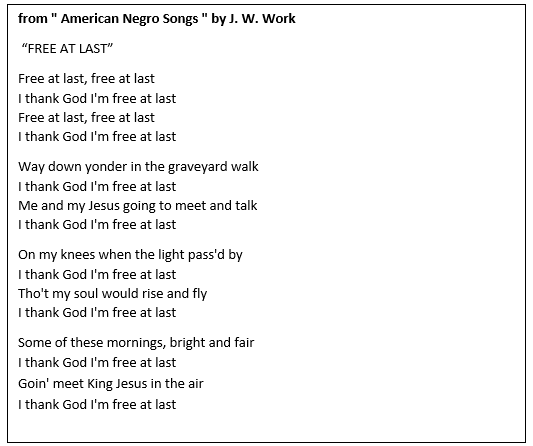
This is what the Apostle Paul was writing about when he wrote the words in Galatians 5:1. Freedom. It is for freedom that Christ set us free. This is the key verse of Paul’s entire letter to the Galatians.
Luke (4:18, 19) recounts the story of Jesus coming to His hometown Nazareth, and going into the synagogue on Sabbath, as was His habit. As He stood up to read from the Scriptures, the scroll of Isaiah was handed to Him, and He read from Isaiah 61:1-2:
“The Spirit of the LORD is upon Me,
Because He has anointed Me
To preach the gospel to the poor;
He has sent Me to heal the brokenhearted,
To proclaim liberty to the captives
And recovery of sight for the blind,
To set free those who are oppressed;
To proclaim the year of the LORD’s favor.”
This is the reason for Jesus’ ministry. Liberty. Freedom.
And we already know that He is The Way, the only way we truly have freedom.
Because otherwise, as we’ve been talking about these last few weeks, we, the believers in Yahweh, the One True God, the God Almighty, would be imprisoned in the law. Imprisoned by our works and deeds.
Paul is repeating, in the first part of the chapter, the topics we’ve been talking about: the law, legalism, grace by Christ. And one of the points he makes is that if you keep even just one part of the law (in this case, circumcision), then you’ve pretty much given up on the whole idea of grace—faith alone. They are mutually exclusive. They cannot both be true. If legalism is true, then grace cannot be. If grace is true, then legalism cannot be.
That’s why we had the discussion last week where we talked about some examples of legalism. These examples of legalism are in direct contradiction to God’s gift of grace.
No, we have a different kind of freedom, an exciting liberty!
Martin Luther says this kind of liberty is in the conscience. He says, “Our conscience is free and quiet because it no longer has to fear the wrath of God. This is real liberty…Who can adequately express the boon that comes to a person when he has the heart-assurance that God will nevermore be angry with him, but will forever be merciful to him for Christ’s sake? This is indeed a marvelous liberty, to have the sovereign God for our Friend and Father who will defend, maintain, and save us in this life and in the life to come.”
It’s liberating, this kind of liberty. We are free!
But, Luther goes on to say, “Christ is your liberty and life. Therefore, law, sin, and death may not hurt you or drive you to despair. This is the constitution of your priceless liberty. Now take care that you do not use your wonderful liberty for an occasion of the flesh.”
Why this warning all of a sudden? Well, because Satan likes to turn this liberty into licentiousness: with that comes willful immorality, recklessness, shamelessness.
Paul tells us in verse 13, “Do not use your freedom to indulge the sinful nature…”.
Just because we have liberty, doesn’t mean that we’re free to do whatever we want. We can’t tell ourselves it’s OK as long as we believe the right doctrines. We can’t say “I’m free, so I can do what I want!” Or, “If salvation isn’t a matter of deeds, then I don’t need to do anything for poor people,” for example. In answer to this question of “can we do anything we want?” Paul says, “By no means! We died to sin; how can we live in it any longer?” (Romans 6:1-2). As Christians we must not allow our freedom to become a place for sin to take hold. Because once started, sin can become a stronghold.
Instead, we are to serve one another in love. Because the essence of the law is summarized in this: Love your neighbor as yourself. In order that we don’t abuse our liberty, Paul establishes a rule of mutual love so that we will serve one another in love, bear the weaknesses of our brothers, forgive one another. We serve one another in love because it’s easy to get turned the other way. We need to focus our minds on others because our minds tend to want to be focused on ourselves. We have a fleshly nature, a sinful nature that focuses on the things that we want. We do possess a sin nature, so we can’t totally get rid of it. But we need to control and subdue it. So how do we do that? We know that we definitely cannot do it on our own. We’ve talked about this many times in the past.
We need help, from the Helper. Our Christian freedom is found in the person of the Holy Spirit! Think of it this way, ladies: God Himself has entered us with His gift of power. The Holy Spirit.
Paul refers to the Spirit quite a few times. He tells us to live by the Spirit, be led by the Spirit, keep in step with the Spirit. And in this way we will not gratify the desires of our sinful nature. If we surrender ourselves to the Spirit to let Him guide and control us, the Spirit will see to it that we don’t indulge the desires of our sinful heart.
The sin nature produces fruit in our lives. If we don’t let the Holy Spirit have control over our lives, the fruits of our sinful nature creep in. As long as our sinful nature is in control and its desires are expressed in our actions, Paul’s list of evils will appear in our lives.
But when we live by the Spirit, are led by the Spirit, and keep in step with the Spirit, the fruit of the Spirit is evident in our lives. The fruit–love, joy, peace, etc., things that we all desire–are in contrast to the fruit produced by our sinful nature.
So let’s take a look at the last few verses of Chapter 5 where Paul’s comparing and contrasting. I think a chart would be helpful.
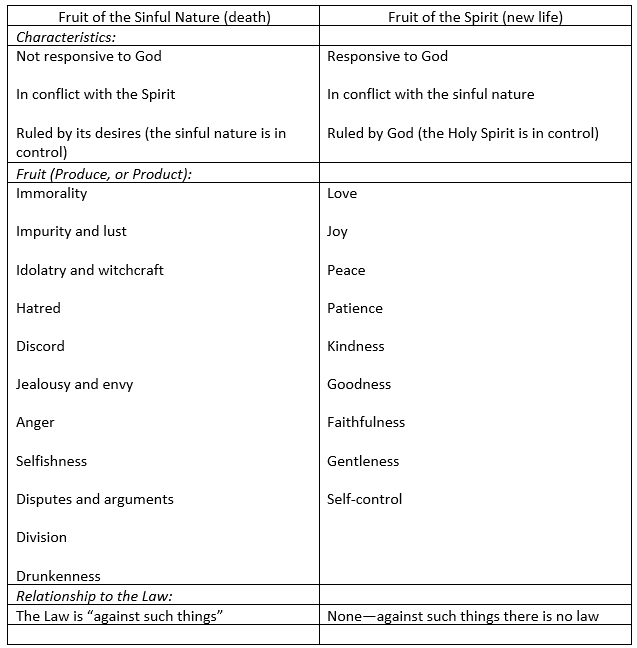
Next week we’ll talk more about the Fruit of the Spirit, but I wanted you to have this background understanding before we dive in to that.
The Teacher’s Commentary, Lawrence O. Richards, Copyright 1987 by Victor Books, a division of Scripture Press Publications, Inc., Wheaton IL
The Zondervan NIV Bible Commentary: Volume 2: New Testament, consulting editors Kenneth L. Barker and John R. Kohlenberger III, Copyright 1994 by Zondervan Publishing House
Commentary on Galatians, by Martin Luther, translated by Theodore Graebner, this edition Copyright 2019 by Digireads.com Publishing


Leave a Reply